Three layers, a schedule and a few cards
Stillna sorts your phone’s apps into three layers and closes them on a schedule the app suggests, or when you hold a card to the phone.
How the layers workWhat goes where?
The app comes with ready-made suggestions, built on the research we have gathered. Both the layers and the schedule can be changed to suit you.
Lugn
What you really need
Phone, Messages, Camera, Maps, BankID, your bank’s app, Swish, Wallet, Weather, Notes and public transport.
Always open
Produktiv
What you use now and then
Mail, Calendar, the web and documents, travel bookings, exercise, apps for home electronics and film apps without a feed.
Open 07–21
Flöde
What you tend to scroll a little too long
Social media, video, games, news and shopping. Everything that is hard to put down.
Open 11–20
The times in the schedule are the app’s suggestion. Change them in the app to suit your needs.
07:00
Produktiv opens.
Mail, calendar, work and school.
11:00
Flöde opens.
Social media, video and games, with a limit for the day. Research shows that cutting down lasts better than giving up entirely.2
18:30
Middag
Hold the card to the phone.* Produktiv and Flöde close while you eat.*The cards are sold separately. You can also close a layer early in the app, without a card.
20:00
Flöde closes.
There is no button for five more minutes. Research shows that a limit that locks reduces use more than a warning you can dismiss.1 Flöde opens again at eleven.
21:40
Need your email anyway?
Produktiv closed at nine, but can be opened early. Copy the sentence Stillna shows and put the phone face down. It takes a few minutes, on purpose. Research shows that a short pause before an app is enough for many people to leave it alone.6
22:30
The phone is boring now.
That is the idea.
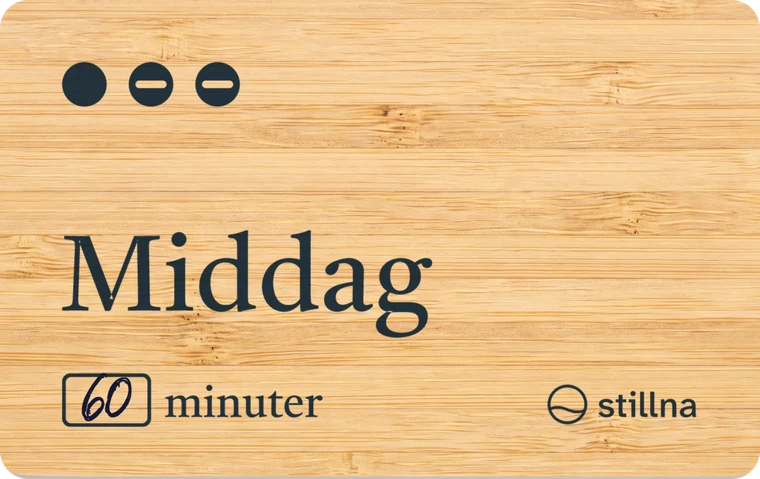
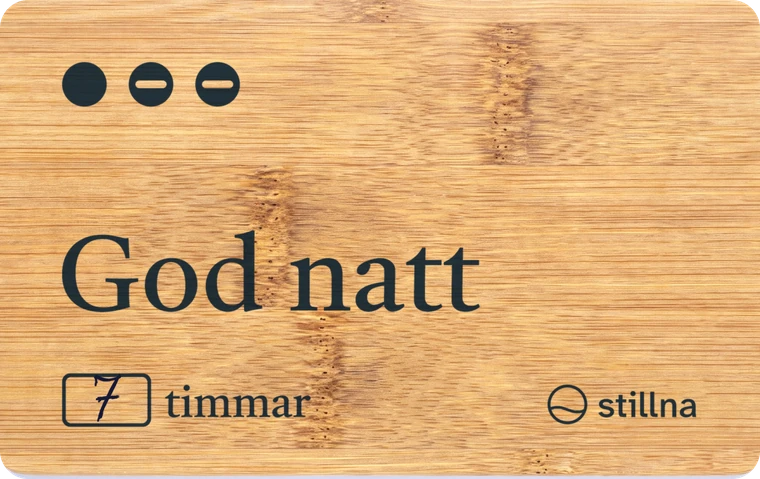
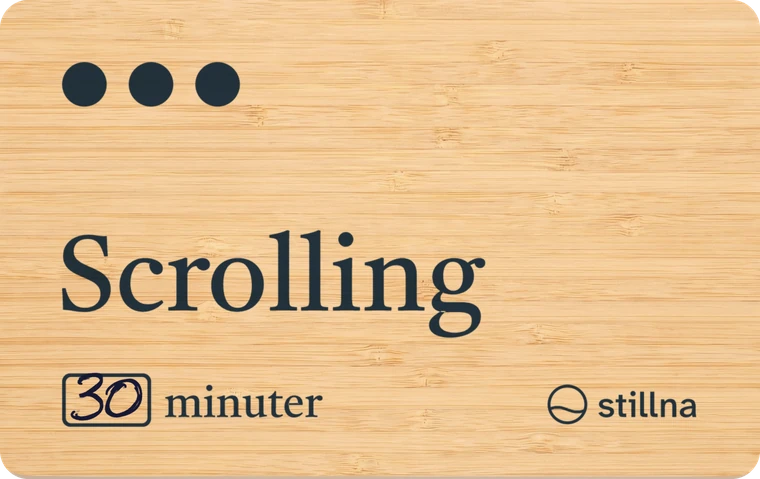
Close the layers without going into the phone.
The idea behind the card comes from research on habits in other fields. A quick check easily leads on to more,3 but with an object that sits outside the phone it is easier to resist an impulse in the moment.4 Hold the card to your phone, or to your children’s,5 and the layers close.
Sources
- In a field experiment with 36 people, phone use fell by 74 minutes per weekday when the limit locked the phone, while a warning that could be dismissed gave no significant reduction. Kim, Jung, Ko and Lee, Proceedings of the ACM on Interactive, Mobile, Wearable and Ubiquitous Technologies, 2019. doi.org/10.1145/3314403
- In a randomised study with 619 participants, the reduction held better four months later among those who cut their use by an hour a day than among those who abstained completely for a week. Brailovskaia et al., Journal of Experimental Psychology: Applied, 2023. doi.org/10.1037/xap0000430
- Studies of phone habits have found that a quick check of the phone sometimes leads on to other use. Oulasvirta, Rattenbury, Ma and Raita, Personal and Ubiquitous Computing, 2012. doi.org/10.1007/s00779-011-0412-2
- In two field experiments, students asked to change their surroundings reached their study goals more often than those asked to resist temptation. Duckworth, White, Matteucci, Shearer and Gross, Journal of Educational Psychology, 2016. doi.org/10.1037/edu0000062
- Stillna must be installed on every phone the card is to close.
- In a six-week study with 280 participants, users closed the app again in 36 per cent of attempts when the app one sec added a short stop and asked whether they wanted to continue. Grüning, Riedel and Lorenz-Spreen, PNAS, 2023. doi.org/10.1073/pnas.2213114120